
Most startup ideas die for one simple reason: the founder built something nobody wanted. And the painful part is that this expensive lesson was completely avoidable. If you are searching for how to validate startup idea with no money, you are already ahead of most first-time founders, because the cheapest moment to discover a bad idea is before you spend a single dollar on it. Validation means gathering real evidence that strangers will pay for what you plan to sell, and you can collect that evidence without a budget, without code, and without a network. In this guide, you will learn how to validate startup idea with no money using seven free methods that real founders actually use — from smoke-test landing pages to pre-sale campaigns. You do not need an MBA or a marketing budget. You need curiosity, a notebook, and the discipline to listen to what the market tells you, even when the answer is no.
Why Validation Matters More When You Have No Budget
When you have funding, a failed idea is an expensive mistake. When you have no money, a failed idea is months of unpaid work lost forever. That is why validation is even more critical for broke founders: your time is your only capital, and spending six months building the wrong thing is worse than spending money on it. Studies of failed startups consistently point to “no market need” as the number one cause of death — not competition, not bad technology, just building something nobody asked for. A few weekends of validation conversations can save you a year of misdirected effort. The good news is that customers do not care about your budget. They care whether you solve their problem. Every method below costs nothing but time, and each one produces a different kind of evidence: what people say, what people do, and what people pay for. That is why the best advice on how to validate startup idea with no money always starts with conversations, not tools: talking to strangers is free, and it produces richer evidence than any paid survey.
7 Free Methods for How to Validate Startup Idea With No Money
Use these methods in order if you are starting from zero. Each one builds on the last, so by the end you will have a clear yes, no, or pivot decision backed by real data instead of gut feeling. Together, they form a complete playbook for how to validate startup idea with no money, ordered from cheapest insight to strongest proof.
1. Problem Interviews With Strangers
Before you mention your idea at all, interview 15 to 20 people who might have the problem you want to solve. Ask about their current frustrations, how they cope today, and what they have already tried or paid for. The golden rule: never pitch during a problem interview — the moment you describe your solution, people start being polite instead of honest. You are listening for strong, emotional language about a pain they actively spend money or time to fix. If three different strangers describe the same expensive problem in their own words, you have a validated problem. If everyone shrugs and says “it is fine,” you have saved yourself months of work. Record your notes right after each conversation, because memory lies. To make these interviews work, prepare your questions in advance — see our guide on the 15 startup idea validation questions to ask customers for a complete script you can copy.
2. The Smoke-Test Landing Page
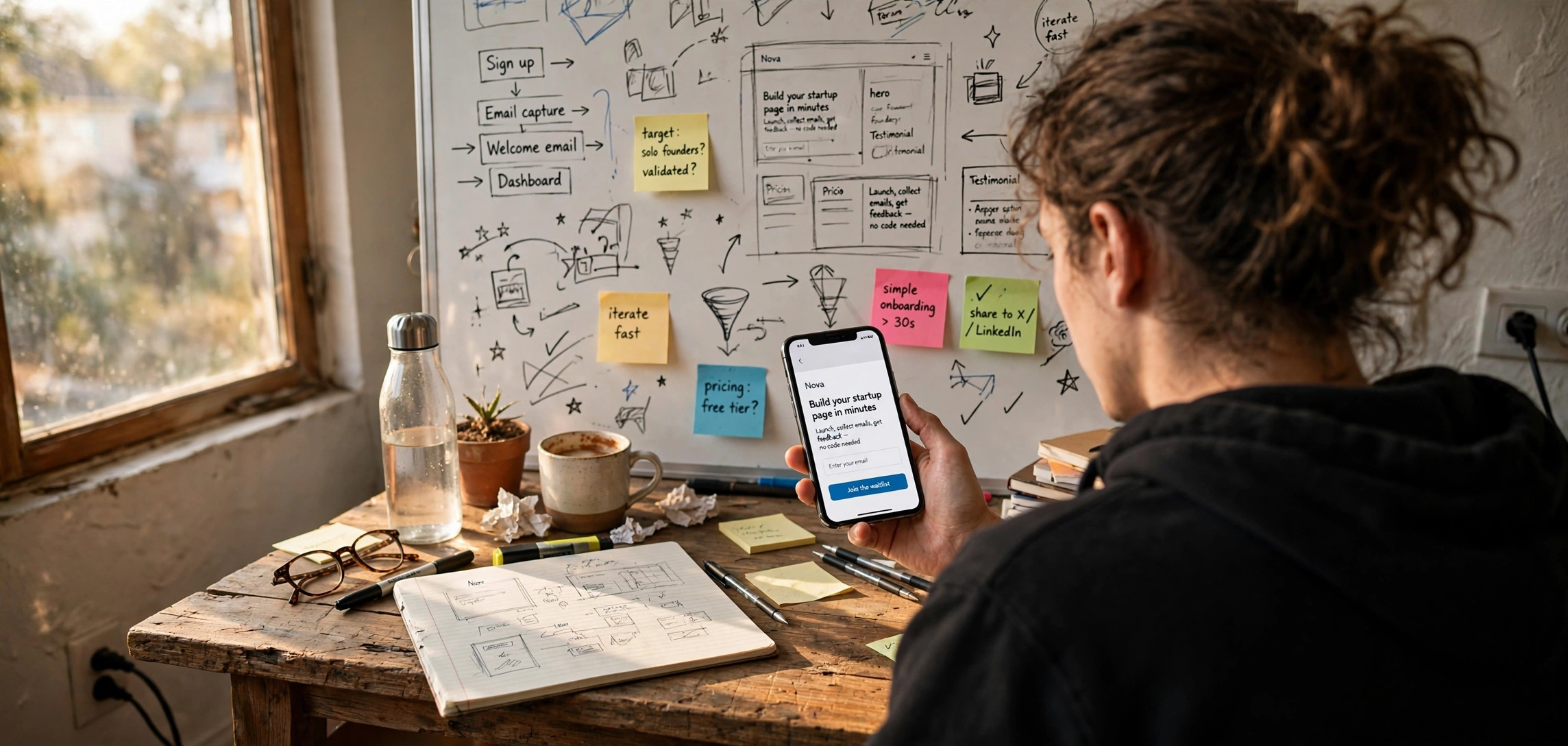
A smoke test means advertising a product that does not exist yet and measuring whether anyone reaches for their wallet. Build a free one-page site using Carrd, Google Sites, or a free WordPress plan. Describe the product, list the benefits, and add a single call to action: join the waitlist, pre-order, or book a demo. Then drive 100 to 200 visitors to it by posting in relevant communities, answering questions on Reddit or Quora, or messaging your target users directly. The math is simple: if 5 to 10 percent of visitors give you an email or attempt to buy, you have demand. If 200 people visit and nobody clicks, the market just voted. This is the fastest way to learn how to validate startup idea with no money online, because the whole test costs zero and takes a weekend. Just be honest on the page — a “join the waitlist” button is a smoke test; a fake checkout that charges cards is a scam.
3. The Concierge Test
Instead of building software, deliver the service manually and pretend it is automated. If your idea is an AI meal-planning app, plan meals by hand for ten customers over WhatsApp and charge them. If it is a freelance-matching platform, match people yourself in a spreadsheet. The concierge test validates two things at once: whether people will pay, and what the real workflow looks like before you automate anything. You will learn more from ten manual customers than from a thousand survey responses, because paying customers reveal their true priorities. Keep your delivery scrappy — use free tools, templates, and messaging apps you already have. When the manual version becomes too painful to sustain, that pain tells you exactly what to build first. For service-style ideas, many founders consider the concierge test the most convincing answer to how to validate startup idea with no money, because it produces paying customers instead of polite opinions.
4. The Wizard-of-Oz MVP
The Wizard of Oz technique is the concierge test’s sneakier cousin: the customer sees a polished front end, but a human does the work behind the curtain. A famous example is the early days of Zapier-style automation tools, where founders manually moved data between apps while users thought software did it. You can replicate this with a simple form on a free site: the user submits a request, you fulfill it by hand within a few hours, and the user experiences a “product.” This tests the full customer experience — onboarding, delivery, and satisfaction — without writing code. If users love it, you know the experience is worth automating. If they churn after one use, you have learned something critical for free. Pair this method with our guide on how to build a minimum viable product without coding when you are ready to automate the parts that proved valuable.
5. Competitor Review Mining
Your competitors’ angry customers are a free focus group. Find three to five competing products on app stores, Google reviews, Trustpilot, or Amazon, and read their one-, two-, and three-star reviews. Look for repeated complaints: features people beg for, bugs that never get fixed, pricing that feels unfair, and support experiences that went wrong. A pattern of the same complaint across dozens of reviews is a validated gap in the market — it tells you exactly what to build and what to avoid. This method takes one focused afternoon and costs nothing, yet it produces a feature list grounded in real frustration rather than your imagination. Take screenshots of the most revealing reviews and keep them in a document; they double as powerful motivation and as copy for your future landing page.
6. The Pre-Sale or Paid Waitlist
Nothing validates like money changing hands. Offer your future product at a founding-member discount and ask people to pay a small deposit or the full pre-sale price before it exists. You can collect payments with zero upfront cost using free tiers of tools like Stripe payment links, Gumroad, or even a simple bank transfer. Set a clear threshold in advance — for example, “if ten people pre-pay, I build it” — and refund everyone if you miss it. A pre-sale forces the ultimate honesty test: people who say “I would totally buy that” often disappear when asked for a card number, and that disappearance is data. Even five pre-sales prove more than five hundred “great idea!” comments. Document every objection you hear during the pitch, because those objections are your future FAQ page. Of all the approaches to how to validate startup idea with no money, the pre-sale is the strictest test: it converts polite interest into committed cash.
7. The Community Immersion Test
Spend two weeks inside the online communities where your target customers already gather — subreddits, Facebook groups, Discord servers, LinkedIn groups, or niche forums. Do not promote anything. Just read, take notes, and answer questions helpfully. You are looking for the questions people ask repeatedly, the tools they complain about, and the workarounds they proudly share. When you understand a community’s language and pain points deeply enough, you can describe your idea in their words and watch the reaction. If your post describing the problem gets strong engagement but your solution post gets silence, the problem is validated and the solution needs work. This method also builds your first audience: the people who see you helping for two weeks become your warmest launch supporters.
Compare the Free Validation Methods Side by Side
| Method | Time Needed | What It Proves | Best For |
|---|---|---|---|
| Problem interviews | 1–2 weeks | The problem is real and painful | Brand-new ideas |
| Smoke-test landing page | 1 weekend | Strangers want the solution | Online products and apps |
| Concierge test | 2–4 weeks | People pay; workflow is clear | Service-style ideas |
| Wizard-of-Oz MVP | 1–2 weeks | The experience delights users | Tech product concepts |
| Competitor review mining | 1 afternoon | A market gap exists | Crowded markets |
| Pre-sale campaign | 1–2 weeks | People pay before it exists | Any idea with a clear offer |
| Community immersion | 2 weeks | You speak the customer’s language | Niche audiences |
5 Mistakes That Produce Fake Validation Results
Bad validation is worse than no validation, because it gives you false confidence. Avoid these traps that every broke founder falls into at least once — because a flawed process for how to validate startup idea with no money produces confidence without evidence.
- Asking friends and family. People who love you will say your idea is amazing. Strangers have no reason to lie, which is why their feedback is the only kind that counts.
- Leading questions. “Wouldn’t you love an app that does X?” gets yeses. “How do you currently handle X?” gets truth. Never ask a question that contains its own answer.
- Counting compliments as validation. “Great idea!” costs the speaker nothing. Only count behaviors: signups, pre-payments, time spent, and referrals.
- Interviewing too few people. Three conversations tell you nothing. Fifteen to twenty reveal patterns. Push past your comfort zone until the answers start repeating.
- Ignoring the “no.” If the market says no, that is the validation working. Pivoting early based on honest data is a win, not a failure — it is exactly what learning how to validate startup idea with no money is supposed to produce.
Frequently Asked Questions
How long does it take to validate a startup idea with no money?
Most founders can run a solid validation sprint in two to four weeks of part-time effort. Problem interviews take one to two weeks, a smoke-test landing page can be live in a weekend, and a concierge test runs for two to four weeks. Do not stretch validation beyond a month without a decision — the goal is a fast yes, no, or pivot, not endless research. Set a deadline before you start and commit to acting on whatever the data says. Whatever mix you choose, keep the sprint short: the whole point of learning how to validate startup idea with no money is speed, not perfection.
Can I really validate an idea without talking to anyone?
Not honestly, no. You can do review mining and community reading silently, but at some point real validation requires real humans reacting to your offer. The good news is that “talking to people” is free — it just takes courage. Online interviews over video calls or even text chat count, so shyness is not an excuse. Every method that produces strong evidence involves another human making a choice.
What is a good conversion rate for a smoke-test landing page?
As a rough benchmark, a 5 to 10 percent email signup rate from targeted visitors is a promising signal, and any pre-sale conversion above 2 to 3 percent is strong. Below 2 percent signup from well-targeted traffic usually means the offer, audience, or messaging needs work. Context matters enormously, though — 50 visitors from a niche community you hand-picked are worth more than 5,000 random clicks. Always judge the quality of traffic alongside the rate.
Should I validate before or after choosing a business name and logo?
Validate first. Names, logos, and branding feel like progress but prove nothing about demand, and founders routinely fall in love with a brand for an idea the market rejects. Spend your early energy on customer conversations and smoke tests. Once you have paying customers or a waitlist of hundreds, then invest time in naming — and when you do, our checklist on the cheapest businesses to start from home shows how far you can get while keeping costs near zero.
What do I do if validation says my idea is bad?
Celebrate — you just saved months of wasted work and possibly thousands of dollars. Then mine your notes for the pivot: which related problem did interviewees mention most? Which feature got the strongest reaction? Most successful startups began as something else, and your “failed” validation is actually a map to the adjacent idea people do want. Run one more two-week validation sprint on the strongest alternative before you build anything.
Conclusion: How to Validate a Startup Idea With No Money — Then Build With Confidence
Learning how to validate startup idea with no money is the highest-leverage skill a broke founder can develop. The seven methods above — problem interviews, smoke tests, concierge delivery, Wizard-of-Oz prototypes, review mining, pre-sales, and community immersion — cost nothing but focused time, yet they answer the only question that matters: will strangers pay for this? Run them in sequence, write down your decision criteria before you start, and honor what the data tells you. When the evidence says yes, you can move forward and build knowing that real demand is waiting. And when it says no, you have lost a few weekends instead of a year of your life — which makes you, paradoxically, richer than the founder who never validated at all. Bookmark this guide and work the methods in order the next time you need to figure out how to validate startup idea with no money — your future self will thank you.