
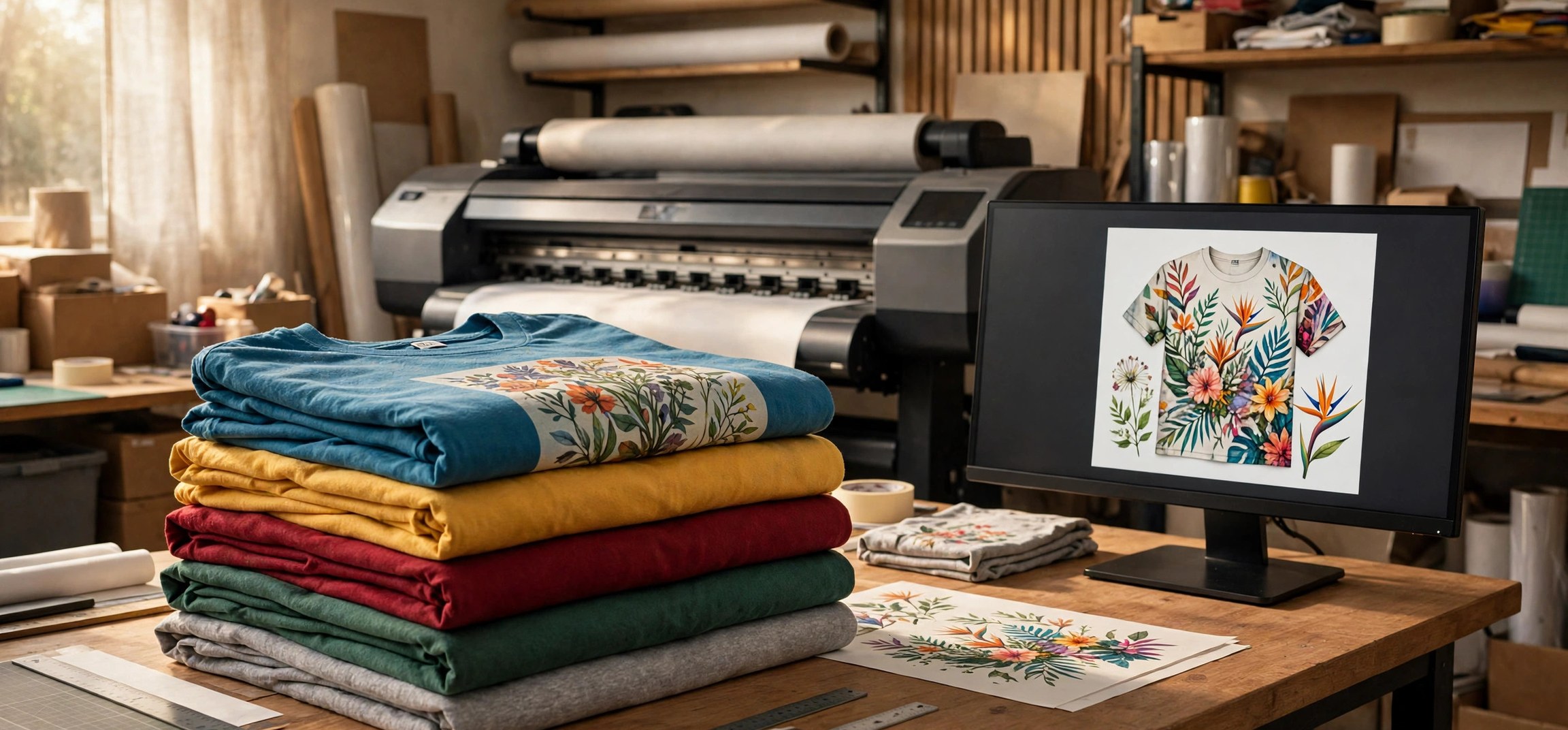
A print on demand business lets you sell t-shirts, hoodies, mugs and posters with your own designs, without buying a single item of stock upfront. Products are printed one at a time, only after a customer has paid, and the supplier ships the order to your customer under your brand. It is one of the lowest-risk ways to start selling physical products online, and also one of the most oversold. This guide covers how the model really works, what it costs, and what a realistic print on demand business earns.
Table of Contents
- How a Print on Demand Business Works
- Print on Demand Business Startup Costs: The Real Numbers
- Choosing a Print on Demand Platform
- Choosing Products and a Profitable Niche
- Design Basics and the IP Rules That Keep Stores Alive
- Connecting Your Store: Shopify vs Etsy
- Pricing Your Products: The Margin Maths
- Order Samples Before You Sell Anything
- Marketing Your Print on Demand Business
- Common Mistakes That Kill New Stores
- Honest Expectations: How Much Will You Actually Earn?
- Frequently Asked Questions
- Conclusion
How a Print on Demand Business Works
The model has four steps. You create a design and list it on a product in your online store. A customer orders and pays your retail price. Your print provider receives the order, prints your design on a blank product, packs it and ships it to the customer. You pay the provider its base cost plus shipping, and you keep the difference.
The money flow is the whole appeal: you are paid before you spend anything on the product. If a design never sells, you have lost design time, not a garage full of unsold shirts. The trade-offs are margin (single-item printing costs far more than bulk) and control (you never inspect products before they ship).
Print on Demand Business Startup Costs: The Real Numbers
Anyone who says a print on demand business costs thousands to start is selling something, and anyone who says it costs nothing has skipped the sample order. A realistic lean launch looks like this:
- Print provider account: $0. Printful, Printify and Gelato all have free plans; you pay per order, not upfront.
- Selling channel: $0.20 per listing on Etsy (listings last four months), or Shopify Basic at $29 a month billed annually, plus around $12 to $15 a year for a domain.
- Designs: $0 if you make them yourself with free tools, or roughly $5 to $50 per design from a freelance designer.
- Samples: roughly $10 to $40 per product. Budget for at least two or three.
That puts a sensible launch budget at $50 to $150, which is why a print on demand business regularly tops lists of the cheapest businesses to start from home. Low startup cost does not remove the paperwork, though: register for tax once sales begin.
Choosing a Print on Demand Platform
Your provider decides your product quality, base costs and delivery times. The four names worth comparing:
- Printful: Prints in its own fulfilment centres, so quality is consistent, at higher base prices; a paid Growth plan (around $24.99 a month) unlocks product discounts once orders are steady. Start with Printful if reliability matters more than the last dollar of margin.
- Printify: A marketplace of 90+ print providers: you pick the printer per product, competition keeps base costs low, and quality varies more. Free to start; Premium (around $29 a month) cuts product costs by up to 20 percent.
- Gelato: Produces locally in more than 30 countries, so international customers get faster delivery and fewer customs surprises.
- Spring (formerly Teespring) and Redbubble: Marketplaces, not providers: upload designs, they run the store and printing, you keep what you set above their base price. Zero cost, least control.
Before listing anything, check three things in the live catalogue: your main product’s base cost, fulfilment time (typically 2 to 7 business days), and how close production is to your customers.
Choosing Products and a Profitable Niche
Beginners usually get this backwards: they pick a product, then look for buyers. Do it the other way round. Pick a specific audience with a shared identity (trail runners, new nurses, vintage motorcycle owners, board-game groups), then sell them products they already buy: t-shirts and hoodies first, then mugs, totes, posters and stickers.
A good niche passes three tests. The audience buys gifts for each other, because gift buyers are less price-sensitive. The identity can be expressed in a joke only insiders fully get. And you can think of twenty design ideas in an afternoon. Start with 5 to 10 designs on one or two products and expand what works, instead of launching 200 listings into the void.
Design Basics and the IP Rules That Keep Stores Alive
Technically, designs are simple. Work at 300 DPI, export transparent PNG files, and size artwork for the print area (around 4,500 x 5,400 pixels for shirt fronts). Bold, simple designs with strong contrast print better and read better in thumbnails than fine detail.
The legal side is where stores die. Never print:
- Band, film, anime, game or sports-team artwork, logos or characters
- Celebrity names, faces or song lyrics
- Brand names, in the design or in your listing titles and tags
- Other sellers’ designs you found on Etsy or Pinterest
Copyright protects artwork; trademark protects names, logos and even some phrases, and both apply to a print on demand business exactly as they do to any other retailer. Platforms act on complaints with strikes, and repeat strikes close stores permanently, taking your listings and reviews with them. Before using a phrase, search the US trademark database (USPTO) and your local equivalent. AI image generators do not solve this: they happily produce lookalike characters, their commercial terms vary, and no generator can grant you trademark rights.
Connecting Your Store: Shopify vs Etsy
Both main channels connect to the big providers in a few clicks: install the Printful or Printify app, push your products across with prices and mockups, set your shipping profiles to match the provider’s rates, and place a test order.
Etsy is the easier start: built-in search traffic, $0.20 listings, and buyers already shopping for gifts and custom items. The costs are real, though: transaction and payment fees take roughly 13 percent of a typical sale, and you compete beside millions of similar listings. Shopify costs $29 a month billed annually but gives you your own store, customer data and better margins; the hard part is bringing your own traffic. Many sellers start on Etsy to validate designs, then add Shopify for the winners.
Pricing Your Products: The Margin Maths
Pricing is where a print on demand business is won or lost, so here is a real worked example using a classic Gildan 5000 t-shirt through Printify:
| Item | Amount |
| Base cost (blank, print and fulfilment) | $8.50 |
| US shipping charged by provider | $4.75 |
| Your total cost | $13.25 |
| Your retail price | $27.95 |
| Etsy fees (approx. 13 percent, incl. listing) | -$3.70 |
| You keep, per sale | about $11 |
That is roughly a 40 percent margin, matching what the providers report: Printful puts typical POD margins at 20 to 40 percent, and Printify suggests 40 percent as a 2026 target. The formula is simple: retail price = total cost divided by (1 minus your target margin). Want 40 percent on a $13.25 cost? $13.25 divided by 0.6 = $22.08 is your floor before fees, which is why serious sellers price tees at $25 to $30, not $16. Through Printful the same shirt might cost $16 to $17 all-in (a Bella+Canvas 3001 base of $11.69 plus shipping), so you would price at $29.95 and keep around $10: less margin, bought back in consistency. The same thinking applies to your own stock: the principles in our guide on how to price handmade products to sell online transfer directly.
Order Samples Before You Sell Anything
Order your own best designs, on the exact products and sizes you plan to sell. Check print placement and colour, fabric quality, sizing accuracy and how the package arrives. Providers discount samples (Printful, for example, takes 20 percent off sample orders).
Samples do three jobs: they catch quality problems before a customer does, they give you real products to photograph and film (which outperforms supplier mockups), and they tell you the true delivery time to quote in your listings. Skipping samples is the most common false economy in this business: your first negative review will cost more than the sample would have.
Marketing Your Print on Demand Business
No traffic, no sales: the provider handles printing, but finding buyers is entirely your job. Short videos of the design process, the sample unboxing and the finished product work well on TikTok, Instagram and Pinterest, with Pinterest sending steady, free traffic to gift products. On Etsy, search is the marketing: research the phrases buyers type with a keyword tool, and use them in your titles and tags.
Once a design shows signs of life, small paid tests ($5 to $10 a day for a few days) tell you whether it can scale; kill losers fast. Collect emails from day one with a small discount offer, because repeat buyers from your own list are the cheapest sales you will ever make. Sellers who treat it as a brand, adding products their audience asks for, are the ones still trading a year later. The same audience-building skills later apply to models like starting a subscription box business on a budget.
Common Mistakes That Kill New Stores
- Pricing too low. At $16 a shirt you keep almost nothing after base costs and fees, so one refund wipes out a week of profit.
- Skipping samples. You are selling a product you have never touched.
- No niche. Fifty unrelated designs means no audience ever recognises your store.
- Copying designs. Beyond the legal risk, copies compete with the original on price alone.
- Promising fast delivery. Production takes 2 to 7 business days before shipping; say so clearly, or reap the complaints.
- Expecting passive income. The stores that earn are worked on weekly: new designs, better listings, more content.
Honest Expectations: How Much Will You Actually Earn?
Here is the part the course sellers skip. Most new stores earn little or nothing in their first months: under $100 a month is typical for beginners in months one to six, and many stores never sell at all. Your profit per sale will likely sit between $5 and $12, so meaningful income is a volume game: $500 a month needs roughly 50 to 80 sales a month at typical margins.
The realistic shape of success is slow compounding: a few designs that sell weekly, a store that looks more like a brand each month, and marketing that keeps feeding it. Give it a fair test: 20 to 30 decent, original designs in one niche, properly priced, samples checked, and weekly marketing for three to six months. Growing by then? It can become a solid side income. Nothing sold despite real traffic? The niche or the designs are the problem, and changing them is cheaper here than in any other retail business.
Frequently Asked Questions
How much money do I need to start a print on demand business?
A realistic budget is $50 to $150: a free provider account, Etsy listing fees at $0.20 each (or Shopify at $29 a month billed annually), and two or three product samples. Skipping samples to save $30 is the classic false economy here.
Printful or Printify: which is better for beginners?
Printful if you value consistent, in-house quality and simple operations, and accept higher base costs. Printify if you want the lowest base costs and the widest product range, and accept that quality varies by provider, so sample testing matters more. Many sellers start with one and add the other once orders are steady.
How much profit do you make per shirt?
Typically $5 to $12 per shirt after base cost, shipping and marketplace fees, on retail prices of $25 to $30. Pricing lower destroys the margin: at $16 to $18 a shirt, most sellers keep under $2 a sale. Aim for a margin of 30 to 40 percent.
Can I use designs I find online or generate with AI?
Only if you own the rights or have a proper commercial licence. Designs found on social media or other stores belong to someone else, and trademarked names, characters and phrases are off limits even if you redraw them. AI-generated art needs a licence check too, and it never clears a trademark.
How long does it take to get the first sale?
Anywhere from a few days on Etsy with a well-matched design and good keywords, to several months if you rely on a new Shopify store with no audience. Treat the first three months as testing.
Conclusion
A print on demand business is a genuinely low-risk way to sell real products: no stock, no upfront printing costs, and a launch budget of $50 to $150. Pick one niche, use a reliable provider, price for a 30 to 40 percent margin, check your samples, and market every week. Do those unglamorous things consistently, and a print on demand business gives you something rare: a store whose biggest asset, your designs, costs nothing to hold.