
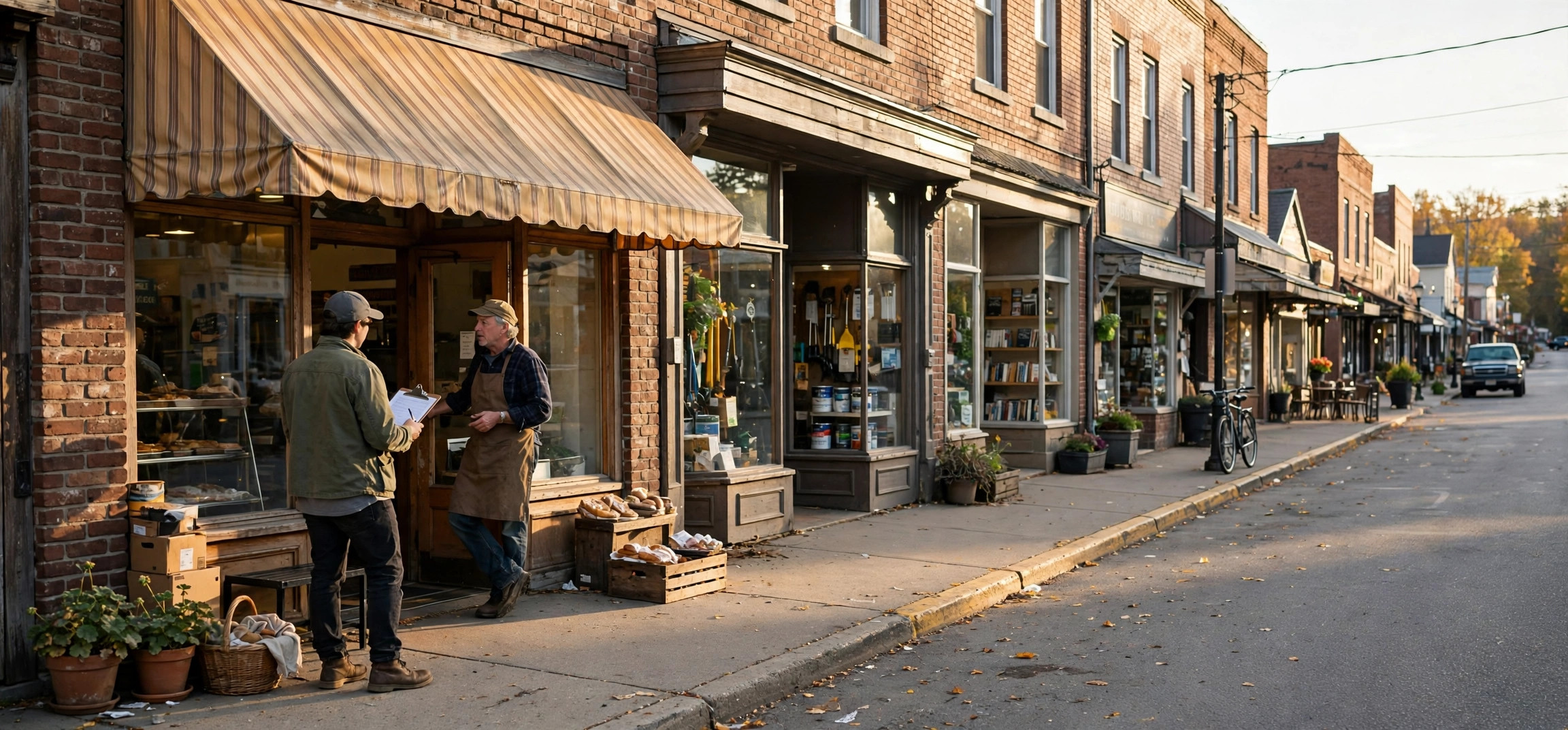
Opening a business in a small town is a different game from launching in a city. Your total market might be a few thousand people, everyone knows everyone, and a single misjudged location or price point can sink you before word of mouth ever gets going. That is exactly why learning how to do market research for a small town business is the highest-return work you can do before you sign a lease or buy inventory. The good news: small-town research is cheaper, faster, and more personal than big-city research. You can literally walk your entire market in an afternoon and talk to a meaningful share of your future customers in a week. This guide shows you how to do market research for a small town business with eight practical, mostly free methods — from door-to-door conversations to census data — plus the mistakes that trip up newcomers and a step-by-step way to turn findings into decisions.
Why Small Town Market Research Is Different (and Easier)
In a city, your market is a statistical abstraction — you sample it, model it, and hope the sample represents the whole. In a town of 5,000 people, your market is a community you can know by name. That changes everything about research. First, sample sizes are small enough that twenty good conversations can genuinely represent demand. Second, purchase behavior is visible: you can watch which stores are busy, which restaurants have lines, and which shelves gather dust. Third, trust travels fast — one respected local’s endorsement reaches half the town by the weekend, and one bad experience does the same. The flip side is that mistakes are public and sticky. A city business can quietly pivot; a small-town business that launches wrong gets a reputation that follows it. So research is not optional here — it is your reputation insurance. That is why learning how to do market research for a small town business pays back faster than almost any other pre-launch work. The methods below exploit the small town’s advantages: walkability, visibility, and the fact that people will actually talk to you.
8 Practical Methods: How to Do Market Research for a Small Town Business
Work through these in roughly this order. The first four cost nothing and can be done in a single week; the later ones add precision before you commit money.
1. Walk Your Trade Area Like a Detective
Define your trade area — the geography your customers will realistically travel from, usually a 10 to 20 minute drive in rural areas. Then walk and drive every commercial street in it with a notebook. Count the businesses in your category and adjacent categories. Note which ones look busy at different times of day and which look tired: faded signage, empty parking lots, and “for lease” signs are data. Visit as a customer — buy a coffee, browse the shelves, observe the clientele and price points. Talk to owners; small-town merchants are often surprisingly candid about what works. You are building a mental map of supply: who serves this market today, how well, and where the gaps are. One afternoon of structured walking beats a week of online guessing.
2. Run Door-to-Door and Main-Street Conversations
In a small town, the most powerful research tool is a friendly conversation. Spend a few days talking to people where they gather — the diner at breakfast, the hardware store, the post office line, youth sports sidelines. Keep it casual and short: “I am thinking about opening [business type] here — what do you think this town is missing?” People love being consulted, and you will hear remarkably specific answers: “we drive forty minutes for decent pizza,” “there is nowhere for teenagers to hang out,” “I wish someone did mobile dog grooming.” Aim for thirty to fifty conversations and write down exact phrases afterward. Patterns will jump out by conversation twenty. No spreadsheet teaches you as much about how to do market research for a small town business as fifty face-to-face conversations. This is the heart of how to do market research for a small town business — direct, human, and impossible to fake.
3. Survey the Town Online for Free
Complement your conversations with a short online survey shared in local Facebook groups, community pages, and the town’s subreddit or Nextdoor area if one exists. Keep it to five to eight questions: what they buy now, where they go for it, what frustrates them, and what they would support locally. Offer a small incentive like a gift-card drawing to boost responses. In a town of a few thousand, even eighty to a hundred responses is a meaningful sample. The survey also serves a second purpose: it announces your intentions and starts building an audience. People who answer your survey become your warmest opening-day customers — capture emails (with permission) and you have a launch list before you spend a dollar on marketing. When you are ready to make that list visible, our guide on how to set up a Google Business Profile for a new company shows how to claim your free local listing.
4. Mine Free Census and Government Data
Government data tells you who lives in your trade area: median age, household income, population trends, and commuting patterns. In the US, the Census Bureau’s QuickFacts and data.census.gov give you town-level demographics free; most countries publish equivalents. Look for three things: whether the population is growing or shrinking (a shrinking town is a shrinking market), the age distribution (a town of retirees and a town of young families need different businesses), and median income (which sets your pricing ceiling). Also check your county’s economic development office — many publish retail gap analyses showing which spending categories leak to other towns. That leakage data is essentially a pre-made opportunity list: if residents spend millions on dining outside the county, a restaurant concept has documented demand. Free public data is an underused shortcut in how to do market research for a small town business — use it before you spend anything.
5. Study Competitors’ Customers, Not Just Competitors
Most founders research competitors by looking at the businesses. Research their customers instead. Sit in the parking lot (discreetly) and count traffic at different hours. Read every Google and Facebook review of local competitors — the complaints reveal unmet needs and the praise reveals what to copy. Ask residents where they go when the local option disappoints them; the answer “we drive to [bigger town]” maps your true competition, which is often thirty minutes away rather than across the street. If you are considering food service, our breakdown of startup costs for a food truck in a small town pairs well with this competitor work, since it shows what lean mobile competitors actually spend.
6. Test Demand With a Pop-Up or Pre-Sale
Before committing to a lease, sell in miniature. A weekend pop-up at the farmers market, a one-day stall at a town festival, or a pre-sale campaign for your opening week all test the same thing: will these specific people pay real money? Price it exactly as you plan to price the real business — discounting for the test corrupts the data. Set a clear success bar in advance, such as “fifty paying customers across two weekends.” A pop-up that sells out tells you more than any survey, and it doubles as marketing: every customer becomes a word-of-mouth node in a town where news travels fast. If the pop-up flops, you have learned a cheap lesson instead of an expensive one.
7. Interview Local Gatekeepers
Every small town has gatekeepers — the chamber of commerce director, the bank branch manager who sees every business loan, the commercial realtor, the newspaper editor, the pastor or coach everyone knows. These people hold aggregated knowledge no dataset contains: which businesses quietly thrive, which locations are cursed, what the town tried and abandoned five years ago. Buy them coffee and ask three questions: what does this town need, what has failed here and why, and who should I talk to next? The third question snowballs your network. Gatekeepers also become allies — the chamber director who advised you will promote your opening, because your success becomes their story too. Gatekeepers compress months of trial and error, which is why every serious guide to how to do market research for a small town business includes them.
8. Map Seasonality and Local Rhythms
Small-town economies breathe with seasons, school calendars, harvests, tourist flows, and local events. A business that looks viable on annual averages can starve in February or drown in July. Ask business owners how revenue splits across the year, check when the town’s festivals and school breaks fall, and find out whether summer residents or tourists meaningfully change the population. Then build a twelve-month cash-flow sketch with honest slow months — if the business cannot survive its worst quarter, the idea needs reshaping before you launch. Seasonality research is the method most newcomers skip and most wish they had not.
Free Data Sources for Small Town Research
| Source | What You Learn | Cost |
|---|---|---|
| Census / demographic data | Population, age, income, growth trends | Free |
| County economic development office | Retail gap and leakage analyses | Free |
| Google and Facebook reviews | Competitor strengths and complaints | Free |
| Local Facebook groups | What residents ask for and complain about | Free |
| Chamber of commerce | Business climate, contacts, foot-traffic info | Free / small dues |
| Your own pop-up or pre-sale | Whether people actually pay | Cost of goods only |
Mistakes That Wreck Small Town Market Research
- Researching from behind a screen. Online data describes the town; conversations reveal it. If you have not talked to thirty locals, you have not done the research — and no honest guide to how to do market research for a small town business would say otherwise.
- Assuming your city habits transfer. Pricing, hours, product mix, and marketing that work in cities routinely fail in towns. Validate every assumption locally instead of importing them.
- Ignoring the drive-to competitor. Your competition is not just the shop across the street — it is the bigger town forty minutes away and Amazon. Ask where money actually goes.
- Confusing politeness with demand. “That sounds nice, good luck!” is small-town courtesy, not a purchase order. Count only commitments: pre-orders, deposits, and survey responses with contact details.
- Skipping the failure history. If three similar businesses failed on your street in ten years, find out why before you become the fourth. Survivorship bias makes empty storefronts invisible.
Frequently Asked Questions
How much does market research for a small town business cost?
It can be done for nearly nothing. Conversations, walking the trade area, census data, review mining, and gatekeeper coffees are all free. A short online survey costs nothing on free tiers, and a weekend pop-up costs only your ingredients or inventory. Budget $100 to $300 total for coffee meetings, survey incentives, and a test stall — a trivial sum next to a lease deposit. Professional market research firms exist but are overkill for most small-town ventures; your own legwork produces better local insight anyway.
How long should small town market research take?
Two to four weeks of focused effort is enough for most small businesses. Week one: walk the trade area and start conversations. Week two: run the survey, mine census data, and interview gatekeepers. Week three: run a pop-up or pre-sale test. Week four: synthesize everything into a go or no-go decision with numbers attached. Do not let research become procrastination — set a decision date before you start, and honor it. That pace is realistic because so much of how to do market research for a small town business happens face to face rather than behind a desk. A month of research beats a year of regret.
What if my town already has a business like the one I want to open?
Existing competition is data, not a verdict. Study why customers choose the incumbent and where it disappoints — the review-mining method above is perfect for this. Many small towns support two providers in a category if the newcomer differentiates clearly on quality, hours, or niche. But if the incumbent is beloved, excellent, and the market is tiny, believe the evidence. Sometimes the research answer is “not this idea, not here” — and adjacent ideas from your conversations will point to what the town actually lacks.
How do I estimate how many customers I need to survive?
Work backward from costs. Add up monthly fixed costs (rent, insurance, loan payments, utilities), add your required salary, and divide by your average profit per customer visit. That gives you the monthly customer count you must hit. Then sanity-check it against the town: if you need 2,000 monthly customers in a town of 4,000 people, the math does not work. This break-even calculation is the single most clarifying step in small-town research — run it before you fall in love with the idea. Our guide to the cheapest businesses to start from home is worth a look if the numbers point toward a lower-overhead model.
Should I worry about someone stealing my business idea during research?
Far less than you think. Ideas are common; execution is rare, and in a small town your early conversations actually protect you by building a community that roots for you to be the one who opens it. The bigger risk is the opposite: staying secret, skipping research, and launching blind. Share the concept freely, keep specific financial details private, and move fast once your research gives you the green light.
Conclusion: How to Do Market Research for a Small Town Business — Then Open With Confidence
Learning how to do market research for a small town business comes down to one advantage cities do not have: you can know your market personally. Walk the trade area, have fifty real conversations, survey the town online, mine the free census and review data, interview the gatekeepers, test with a pop-up, and map the seasons. Then do the break-even math honestly and make your decision. Founders who do this work open their doors with a customer list, a differentiated offer, and realistic expectations — instead of hopes and a lease. In a small town, that preparation is not just good business. It is how you become the local success story everyone talks about at the diner.